If you have ever played a casino game, whether online or in a physical venue, you have encountered the house edge. It is the invisible mechanism that keeps the entire gambling industry in business, the mathematical reality that sits beneath every spin, every deal, and every roll of the dice. Yet despite being the single most important concept for any gambling player to understand, the house edge is also one of the most widely misunderstood. Players misinterpret it, exaggerate it, underestimate it, and build entire strategies around flawed assumptions about what it actually means. Some believe it makes winning impossible. Others believe they can beat it with the right system. Both are wrong, and both perspectives lead to poor decisions that cost real money.
This guide strips away the confusion and explains exactly how the house edge works in clear, practical terms. No jargon, no oversimplification, no misleading reassurances. Just the honest mathematics behind every casino game you will ever play, the specific ways that players get it wrong, and the knowledge you need to make genuinely informed decisions about how you spend your time and money at the table or on the screen. Understanding the house edge will not guarantee that you win. But it will guarantee that you stop making the mistakes that most players never even realise they are making.
What the House Edge Actually Is
The house edge is the mathematical advantage that the casino holds over you in any given game. It is expressed as a percentage of your bet that the casino expects to keep as profit over the long run. If a game has a house edge of 2%, this means that for every $100 wagered on that game across millions of bets, the casino expects to keep $2 and return $98 to players. It is not a fee you pay. It is not a tax deducted from your winnings. It is a statistical reality built into the rules and payout structures of the game itself.
The house edge exists because the payout odds offered by the casino are slightly less favourable than the true mathematical odds of a given outcome. In European roulette, for example, there are 37 numbers on the wheel (1 through 36 plus a single zero). If you bet on a single number and win, you receive a payout of 35 to 1. But the true odds of hitting that number are 36 to 1. That gap between the true odds and the payout odds is where the house edge lives. In this case, the house edge on a straight-up roulette bet works out to 2.7%, which means for every $100 wagered on single numbers over thousands of spins, the casino expects to keep approximately $2.70.
This advantage is not set by individual casinos. It is a product of the games themselves. The same game will have the same house edge regardless of which platform or venue you play it at, assuming the rules are identical. A European roulette wheel has a 2.7% house edge whether you are playing at a luxury resort in Monaco or on your phone at home. The casino does not need to cheat, rig, or manipulate anything. The mathematics of the game guarantee their profit over a sufficient volume of bets.
| Key Concept | What It Means | Common Misunderstanding |
|---|---|---|
| House edge percentage | Casino’s expected profit per unit wagered over time | Players think it means they will lose that exact percentage every session |
| True odds vs payout odds | Gap between actual probability and what the casino pays | Players assume payouts reflect true mathematical probability |
| Long-run statistical average | Edge applies over millions of bets, not individual sessions | Players think short-term results reflect the edge accurately |
| Built into game rules | Edge comes from payout structures, not casino manipulation | Players believe casinos actively rig individual outcomes |
| Applies to total wagered | Percentage of all money bet, not just your initial deposit | Players think edge applies only to their starting bankroll |
The House Edge for Every Major Casino Game
Different games carry dramatically different house edges, and understanding these differences is one of the most practical things you can do as a player. Choosing a game with a lower house edge means your money lasts longer on average, you get more entertainment per dollar wagered, and your chances of walking away with a profit from any given session are statistically better.
| Casino Game | Typical House Edge | What Determines the Edge | Skill Factor |
|---|---|---|---|
| Blackjack (basic strategy) | 0.5% | Number of decks, specific table rules | High — proper strategy dramatically reduces edge |
| Baccarat (banker bet) | 1.06% | Fixed rules, no player decisions affect outcome | None — purely rule-based |
| Baccarat (player bet) | 1.24% | Slightly less favourable payout structure | None |
| European roulette | 2.7% | Single zero on the wheel | None — purely chance-based |
| American roulette | 5.26% | Double zero adds an extra losing pocket | None |
| Craps (pass/don’t pass) | 1.36% to 1.41% | Standard dice probability and payout structure | Minimal — bet selection matters |
| Video poker (Jacks or Better) | 0.5% to 2% | Pay table variation and player strategy | High — optimal play is essential |
| Slot machines | 2% to 15% | Game design, RTP set by provider | None — purely chance-based |
| Keno | 20% to 40% | Extremely unfavourable payout structure | None |
| Live game shows (e.g. Crazy Time) | 4% to 10% | Varies by bet type within the game | None |
The range is enormous. A blackjack player using basic strategy faces a house edge of roughly 0.5%, which means the casino expects to keep just 50 paise for every ₹100 wagered. A keno player, on the other hand, can face a house edge exceeding 25%, meaning the casino expects to keep ₹25 or more for every ₹100 wagered. The difference in expected cost between these two games is staggering, yet many players choose games based on theme, excitement level, or jackpot size without ever considering how much their choice is costing them in mathematical terms.
Slot machines deserve particular attention because they represent the widest range of house edges in any single category. A high-RTP slot with a 97% return to player has a house edge of just 3%, which is comparable to many table games. A low-RTP slot with an 85% return to player has a 15% house edge, which means your money erodes five times faster. This information is available for every slot game, usually in the help section or paytable, yet the majority of players never check it before pressing spin.
The Seven Most Common Misconceptions About House Edge
Misunderstanding the house edge leads to bad decisions, unrealistic expectations, and strategies built on foundations that do not exist. These are the seven most prevalent misconceptions that players carry into every casino session, and correcting them is worth more than any betting system ever invented.
The first and most damaging misconception is that the house edge means you will lose a specific percentage of your bankroll every time you play. If a game has a 5% house edge and you sit down with ₹10,000, many players believe they are guaranteed to lose ₹500 during that session. This is fundamentally wrong. The house edge is a long-term statistical average that applies to the total amount wagered, not your starting bankroll. In any individual session, you might win significantly, lose significantly, or land anywhere in between. Variance, not the house edge, determines your short-term experience.
The second misconception is that betting systems can overcome the house edge. The Martingale system, the Fibonacci sequence, the D’Alembert method, and every other progressive or regressive betting strategy ever invented share one critical limitation: they do not change the mathematical house edge of the game. They can alter the distribution of your results, creating the illusion of short-term reliability, but over a sufficient number of bets, the house edge reasserts itself regardless of how you size your wagers. No betting system has ever been mathematically proven to produce a long-term profit against a negative expectation game.
The third misconception is what psychologists call the gambler’s fallacy: the belief that past results influence future outcomes. If a roulette wheel has landed on red seven times in a row, many players feel certain that black is “due” to hit next. In reality, the wheel has no memory. Each spin is an independent event with the same probability distribution regardless of what happened previously. The house edge does not care about streaks, patterns, or what feels like it should happen next.
| Misconception | What Players Believe | Mathematical Reality |
|---|---|---|
| Edge equals session loss | “5% edge means I lose 5% of my bankroll” | Edge applies to total wagered over time, not per session |
| Betting systems beat the edge | “Martingale guarantees long-term profit” | No system changes the underlying mathematical advantage |
| Gambler’s fallacy | “Red is due after seven blacks in a row” | Each event is independent with identical probability |
| Hot and cold streaks are predictive | “This slot is hot, it will keep paying” | Streaks are normal variance, not predictive signals |
| Higher bets reduce the edge | “Betting more improves my odds” | House edge percentage remains constant at any stake |
| Casinos rig individual outcomes | “The casino made me lose that hand” | Outcomes are determined by mathematics and RNG, not manipulation |
| Winning proves the edge is wrong | “I won, so the house edge doesn’t apply to me” | Short-term wins are expected; edge manifests over volume |
The fourth misconception is the belief in hot and cold machines or tables. Players frequently talk about slots being “hot” or “cold,” as if the machine has moods that affect its payout behaviour. In reality, every spin of a properly functioning slot is determined by a random number generator that produces outcomes independent of all previous results. A machine that just paid a jackpot is exactly as likely to pay another jackpot on the next spin as a machine that has not paid out in hours. Perceived streaks are a natural product of random variance, not evidence of a pattern that can be exploited.
The fifth misconception is that higher bets reduce the house edge. Some players believe that wagering larger amounts somehow improves their mathematical position. The house edge is a percentage that remains constant regardless of bet size. Whether you wager ₹10 or ₹10,000 on a single spin of European roulette, the house edge is 2.7%. Your potential win or loss changes with your bet size, but the casino’s mathematical advantage does not.
The sixth misconception is that casinos rig individual outcomes to prevent players from winning. Licensed, regulated casinos use certified random number generators and undergo regular audits by independent testing laboratories. The house edge built into the game’s payout structure is all the casino needs to ensure profitability. Rigging individual outcomes would be illegal, unnecessary, and a massive risk to the casino’s operating licence. The mathematics does the work without any manipulation required.
The seventh misconception is that winning proves the house edge is wrong or does not apply. Players win at casino games every single day. That is not a flaw in the house edge model. It is an expected feature. The house edge describes long-term statistical behaviour across millions of bets, not individual outcomes. In the short term, variance produces winners and losers in unpredictable patterns. The casino profits because the aggregate of all those individual sessions, across all players and all time, converges toward the expected edge.
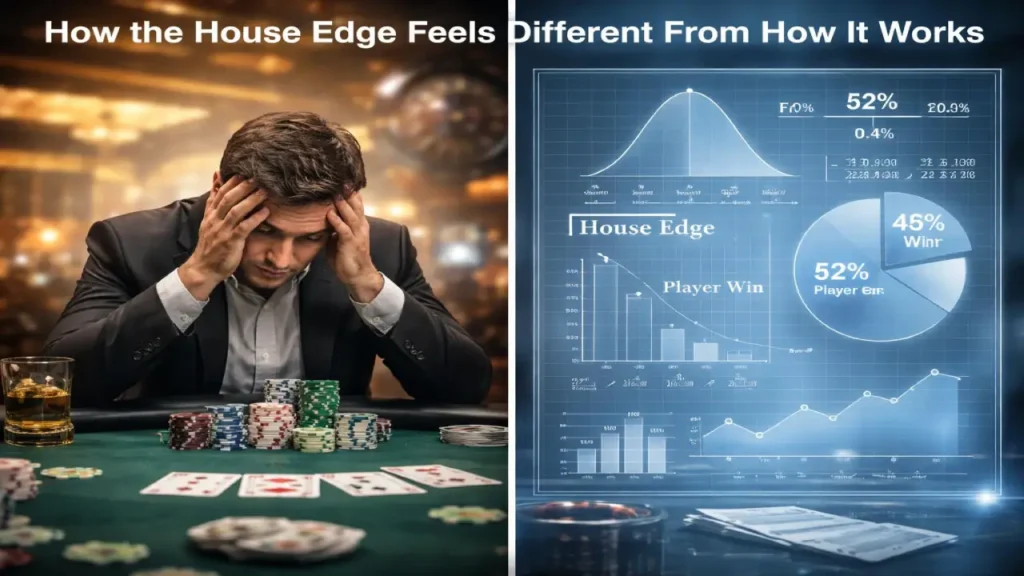
How the House Edge Feels Different From How It Works
One of the reasons the house edge is so widely misunderstood is that the way it functions mathematically and the way it feels experientially are completely different. Mathematically, a 2% house edge is a gentle, almost imperceptible gravitational pull on your bankroll that manifests over thousands of bets. Experientially, a casino session feels like a dramatic rollercoaster of wins and losses where the underlying edge is completely invisible.
This disconnect is caused by variance, which is the natural fluctuation in results that occurs over any sequence of random events. In a game with a 2% house edge, you might be up 50% after an hour of play, or down 30%, or anywhere in between. The house edge tells you almost nothing about what will happen in a single session. It tells you everything about what will happen across thousands of sessions.
Think of it this way. If you flip a fair coin 10 times, you might get 7 heads and 3 tails. That does not mean the coin is biased. It means that 10 flips is too small a sample for the 50/50 probability to manifest reliably. Casino games work the same way. In the short term, anything can happen. In the long term, the mathematics converge toward the expected edge with increasing precision. The casino operates on long-term mathematics. Individual players operate on short-term experience. This fundamental difference in time horizon is the root cause of most house edge misunderstandings.
| Time Horizon | What You Experience | What the Mathematics Predicts |
|---|---|---|
| Single bet | Win or lose, binary outcome | Probability-weighted expected value |
| Single session (1-2 hours) | Dramatic swings, possible big win or loss | Wide variance around expected value |
| 100 sessions | Mix of winning and losing sessions | Trend toward expected edge becoming visible |
| 1,000 sessions | Clear pattern of net loss emerging | Edge increasingly dominant over variance |
| 10,000+ sessions (casino perspective) | Reliable, predictable profit | Near-certain convergence to mathematical edge |
Using House Edge Knowledge to Make Better Decisions
Understanding the house edge does not give you a way to beat the casino. What it gives you is something arguably more valuable: the ability to make informed decisions about how you allocate your entertainment budget. You cannot eliminate the house edge, but you can make choices that minimise it, maximise your playing time, and ensure that you are getting the best possible value for every wager you place.
Choose games with lower house edges when entertainment value is equal. If you enjoy both European roulette and American roulette equally, there is no rational reason to play the American version. The double zero nearly doubles the house edge from 2.7% to 5.26% without adding anything to the experience. Similarly, if you enjoy both baccarat and keno, the mathematical cost of choosing keno over baccarat is enormous over time.
Learn basic strategy for games that reward skill. Blackjack with basic strategy has one of the lowest house edges in the casino at around 0.5%. Blackjack played on gut instinct can have an effective house edge of 2% to 5% or higher, depending on how many suboptimal decisions you make. The difference between informed and uninformed play in skill-dependent games is worth hundreds or thousands of dollars over a playing career. Basic strategy charts are freely available, easy to learn, and represent the single highest-leverage improvement most casino players can make.
Check the RTP of slot games before you play them. This takes seconds and can save you significant money over time. A slot with a 97% RTP (3% house edge) will return roughly ₹97 for every ₹100 wagered over the long run, while a slot with a 90% RTP (10% house edge) will return only ₹90. If you are going to wager the same total amount regardless, choosing the higher-RTP game literally costs you nothing and saves you money.
| Smart Decision | Why It Helps | How Much It Matters |
|---|---|---|
| Choose European over American roulette | House edge drops from 5.26% to 2.7% | Nearly 50% reduction in expected cost |
| Learn blackjack basic strategy | Reduces edge from 2-5% to approximately 0.5% | 75% to 90% reduction in expected cost |
| Check slot RTP before playing | Identifies games that return more per wager | Difference between 3% and 15% edge is enormous |
| Bet banker in baccarat | Lowest house edge bet on the table at 1.06% | Better odds than almost any other simple bet |
| Avoid keno and novelty games | These carry the highest house edges (20%+) | Saves the most money per dollar wagered |
| Set loss limits before playing | Prevents chasing losses during high-variance sessions | Protects bankroll regardless of edge |
| Understand variance vs edge | Prevents misinterpreting short-term results | Leads to better long-term decisions |
The Relationship Between House Edge and Return to Player
Return to Player, commonly abbreviated as RTP, is simply the house edge expressed from the player’s perspective. If a game has a house edge of 3%, its RTP is 97%. If the house edge is 5%, the RTP is 95%. They are two sides of the same coin, and understanding this relationship helps you quickly evaluate any game you encounter.
RTP is the metric most commonly displayed on slot games, while house edge is the terminology more frequently used for table games. The conversion is always straightforward: RTP + House Edge = 100%. When a slot game advertises a 96.5% RTP, it means the house edge is 3.5%. When a blackjack guide tells you the house edge is 0.5% with basic strategy, it means the RTP is 99.5%.
The critical nuance that many players miss is that both RTP and house edge are theoretical values calculated over millions of events. They do not describe what will happen in your next session. A 96% RTP slot will not return exactly ₹96 for every ₹100 you wager today. In a single session, you might return ₹200 or ₹0, and both outcomes are perfectly consistent with a 96% long-term RTP. The percentage tells you about the game’s mathematical structure, not about your personal fortune on any given day.
| House Edge | RTP | What It Means for ₹10,000 Total Wagered (Long-Term Average) |
|---|---|---|
| 0.5% | 99.5% | Expected cost: ₹50 |
| 1% | 99% | Expected cost: ₹100 |
| 2.7% | 97.3% | Expected cost: ₹270 |
| 5% | 95% | Expected cost: ₹500 |
| 10% | 90% | Expected cost: ₹1,000 |
| 15% | 85% | Expected cost: ₹1,500 |
| 25% | 75% | Expected cost: ₹2,500 |
The table above illustrates why game selection matters so much. The difference between a 0.5% house edge game and a 15% house edge game is not a subtle nuance. It is the difference between an expected cost of ₹50 and an expected cost of ₹1,500 for the same ₹10,000 in total wagers. This is real money that compounds over every session, every month, and every year of your playing life. Informed game selection is the most powerful tool you have.
Why the Casino Always Wins in the Long Run But Not in Yours
The statement “the house always wins” is true in aggregate and false in individual cases. The casino always wins in the long run across all players and all bets because the law of large numbers ensures that actual results converge toward the mathematical expectation as sample size increases. But the casino does not always win against you, in your session, on your particular sequence of bets. Understanding this distinction is essential for maintaining a healthy relationship with gambling.
The casino’s business model does not require every player to lose. It requires the total of all activity across all players to produce a predictable margin. Some players win spectacularly. Some players lose spectacularly. Most players experience a mixture of wins and losses that, in aggregate, deliver the expected edge to the house. You are not playing against a system designed to prevent you from ever winning. You are playing within a system that guarantees the casino’s profit across millions of transactions, while leaving the outcome of your individual transactions genuinely uncertain.
This is liberating knowledge, not discouraging knowledge. It means that your session is a real contest with real uncertainty and real possibility. It means that your wins are genuine wins, not illusions permitted by a rigged system. And it means that your losses are not evidence that something unfair happened, but a natural part of a mathematical system that produces both winners and losers in unpredictable patterns.