
Complaints are rare at well-run online casinos, but when something does go wrong, players in Ontario and Alberta can turn to a formal process backed by a provincial regulator. That route is one of the strongest benefits of choosing a licensed site, because it gives you a clear process instead of an inbox that never answers.
Knowing the steps before you need them saves time and stress. It also helps you set fair expectations, since a regulator can do some things for you and not others.
Follow the Route in Five Steps
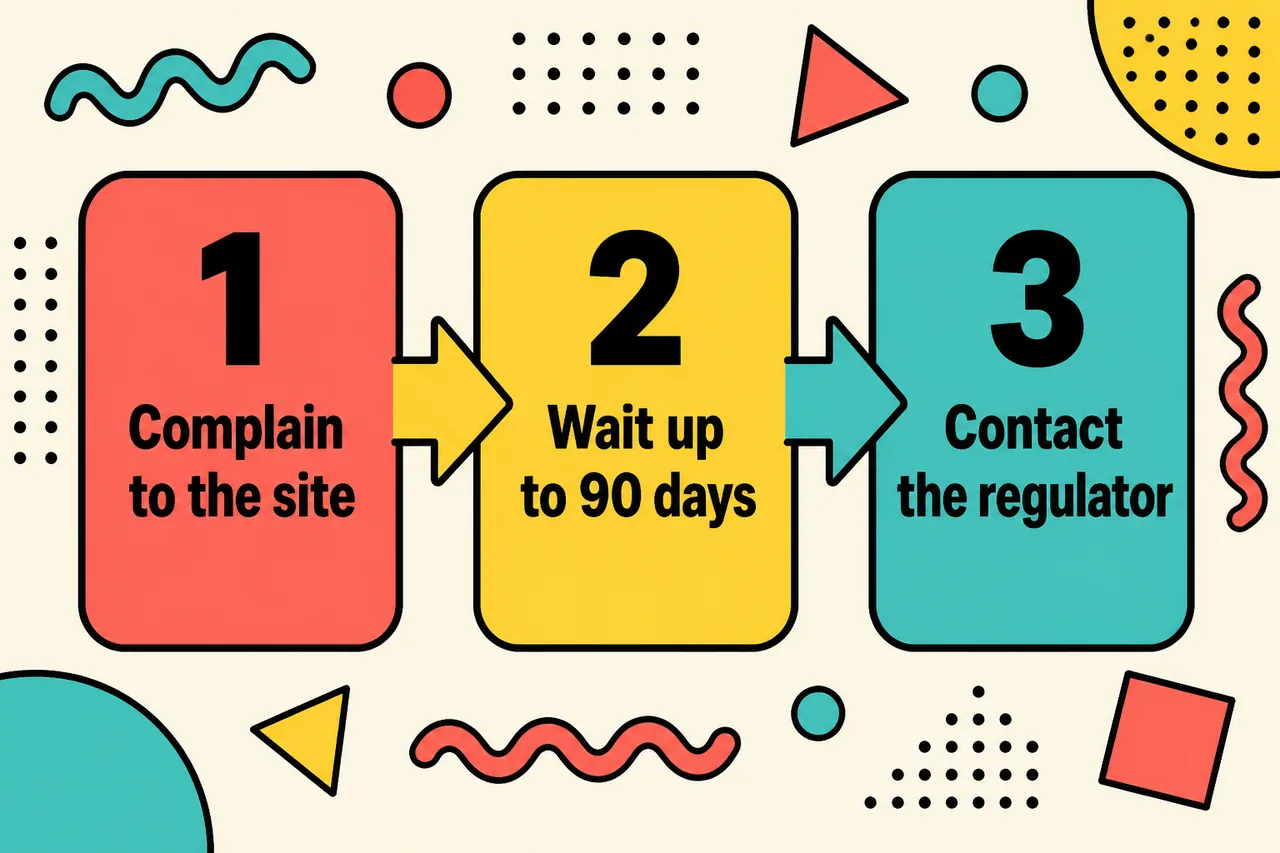
The process is almost identical in Ontario and Alberta. In both provinces it runs in this order.
- Read the site’s terms and conditions that apply to your problem.
- File a formal complaint through the site’s own complaints process.
- Ask for a complaint reference number and keep it safe.
- Wait for a decision, which can take up to 90 days.
- If the site broke the rules or never resolves the issue, take it to the provincial regulator.
Most problems end at step two or three. A clear, polite complaint with the right details often gets a faster answer than a long, angry one.
Gather Your Evidence Before You Write
A complaint is only as strong as the facts behind it. Before you contact anyone, collect everything that shows what happened and when. Put it all in one folder on your device, so nothing gets lost between the first email and any later review.
- Your player ID or account username.
- Dates and times of the events, in order.
- Transaction IDs for deposits, withdrawals or bets involved.
- Screenshots of error messages, balances or offer terms.
- Copies of chat transcripts or emails with support.
- The version of the terms that applied at the time, if you can find it.
Tip. Take screenshots as soon as something looks wrong, before you refresh the page. Balances and messages can change, and a picture taken at the moment is hard to dispute.
Write a Complaint That Gets Read
Good complaints share the same shape. They say what happened, point to the rule that applies and ask for a specific outcome. Keep the tone calm and the length short.
A Simple Structure
Open with your player ID and a one-line summary. Then list the facts in date order. Name the term or rule you believe was broken. Finish with the outcome you want, such as a completed withdrawal or a corrected balance.
Example. “Player ID 12345. On October 2 I requested a C$300 withdrawal, which was approved on October 3 and then cancelled without explanation. Your withdrawal terms say approved requests are paid within the stated period. Please complete the payment or explain the cancellation.” This wording is illustrative.
Ask for a Reference Number
Ontario’s regulator specifically advises players to ask the site for a complaint reference number. It proves you used the operator’s process, and the regulator may ask for it later.
Give the Operator Its 90 Days
Both Ontario and Alberta allow the gaming site up to 90 days to make a decision on a complaint. Regulated sites should explain their process online, including how long a decision usually takes.
Use that time well. Reply promptly to any questions, send documents through your account rather than by email, and keep a diary of every contact.
Note. If you are unhappy with the operator’s final decision, both regulators suggest considering independent legal advice about the dispute. This article is general information, not legal advice.
Know When to Go Straight to the Regulator
Most complaints go to the operator first. Some situations, though, call for the regulator from the start. Ontario’s AGCO and Alberta’s AGLC list three reasons to contact them.
- You believe a regulated site has broken the rules.
- You used the site’s process, waited up to 90 days and still have no resolution.
- Your concern involves responsible gaming, possible illegal activity or advertising, where going to the site first may not be appropriate.
Responsible gaming concerns deserve special mention. If a site ignored your request for limits or self-exclusion, that is a matter for the regulator, not just customer service.
Other examples include a site that kept sending offers after you asked to stop, an ad that seemed aimed at young people, or signs that an operator was not checking ages properly. These issues affect more than one player, so regulators want to hear about them quickly.
File With the AGCO in Ontario
Before you file, confirm the site is regulated. Look for the iGaming Ontario logo or find the brand on the list of registered operators. Then submit your complaint through the AGCO’s online portal, iAGCO. You do not need to create an account to file.
Tip. Include three details to speed things up: the name of the regulated site, your player ID and the complaint reference number from the site.
The table compares how long each stage usually takes in Ontario and Alberta, based on the regulators’ own guidance.
| Stage | Ontario, AGCO | Alberta, AGLC |
|---|---|---|
| Initial review | About 2 business days | About 3 business days |
| Compliance review | Up to 5 weeks | Up to 5 weeks |
| Complex compliance review | 3 to 6 months, sometimes longer | 3 to 6 months, sometimes longer |
File With the AGLC in Alberta
Alberta’s market is newer, having opened on July 13, 2026, but its complaint process already mirrors Ontario’s. The AGLC reminds players that complaining to the regulator does not settle a dispute by itself, so the operator’s process comes first for most account, deposit and withdrawal problems.
During the initial review, the AGLC may ask for more information, suggest you contact the site, close the complaint if no rules were broken, refer you to another regulator or move it to a compliance review.
Good to know. In Alberta, complaints about how often gambling ads appear go to the CRTC or Advertising Standards Canada, since the AGLC does not oversee ad volume.
Understand What a Regulator Can and Cannot Do
Setting the right expectations prevents disappointment. Regulators enforce rules on operators. They do not act as a court for individual payouts.
| A regulator can | A regulator cannot |
|---|---|
| Review whether a site broke the rules | Decide your individual gambling transaction |
| Issue warnings to an operator | Get your money back for you |
| Suspend an operator | Make a site pay you directly |
| Impose monetary penalties | Help with disputes on unregulated sites |
In Ontario’s words, the AGCO “does not resolve or make decisions on disputes regarding gambling-related transactions”. Penalties against a site do not resolve your individual dispute, even when the regulator finds that rules were broken.
That limit is easier to accept when you see the full picture. The operator still owes you a fair answer under its own terms, the regulator watches whether those terms are followed, and independent legal advice remains open for disputes about money. Each part has a job, and together they give licensed players far more support than an unregulated site ever could.
Why Regulator Action Helps You Anyway
If a regulator cannot refund you, why bother? Because its action changes how the operator behaves for you and for every other player. A finding that rules were broken can also strengthen your position if you take further steps.
Enforcement in Ontario is real. The regulator showed this with a $100,000 penalty against one operator, over allegations that included ignoring a customer whose losses passed $2 million within four months.
Good to know. Cases like that one rarely start with a single complaint. They build from patterns that regulators notice across many reports, which is why your complaint counts even when it does not change your own outcome.
Disputes With Offshore Operators
The formal route only exists inside the regulated market. The AGCO says plainly that it can only assist with disputes involving regulated sites.
If your problem is with an unregulated site, you can only pursue it with the operator directly. Any protection depends on that site’s foreign licence, if it has one, and on whether its regulator offers a dispute process.
Warning. This is one of the clearest reasons to play on licensed sites. On an unregulated site, there is no provincial body to turn to when a withdrawal stalls.
Complaints in Other Provinces
Outside Ontario and Alberta, most authorized online casino play runs through a provincial lottery corporation’s own site. Start with that corporation’s customer service and its published complaints process, and keep the same records you would keep anywhere else.
The same principles apply: put the facts in order, name the rule, ask for a reference number and give the organization time to respond.
Note. Provincial lottery corporations are public bodies with their own customer service teams and published policies. A clear written complaint, sent through the channel they list, is the best way to get a considered answer.
Common Reasons for a Complaint
Most complaints fall into a few familiar groups. Knowing them helps you spot the relevant terms quickly.
- Withdrawals that take longer than expected, often because identity checks are still open.
- Disagreements over bonus terms, such as wagering or maximum bet rules.
- Accounts that were limited or closed.
- Limits or self-exclusion requests that were not honoured.
- Marketing sent without consent or after unsubscribing.
For the first two groups, the terms usually decide the outcome, so read them closely before you write. For the last two, the regulator’s role is especially strong.
Keep Calm and Keep Records
Disputes over money can feel personal, especially after a loss. A calm, factual approach works better at every stage and keeps your own judgement clear.
Take a break from playing while the complaint is open. Chasing a disputed balance with new deposits only adds to the amount at stake and muddies the record.
Tip. Write your complaint, then wait an hour before you send it. A second read almost always makes it shorter, clearer and more likely to get a useful reply.
Protect Yourself Before a Problem Starts
The easiest complaint is the one you never need to make. A few habits prevent most disputes before they begin.
- Finish identity checks soon after you open the account, not when you first withdraw.
- Read the withdrawal terms and any bonus terms before you accept an offer.
- Keep deposits and withdrawals on payment methods in your own name.
- Set deposit, loss and time limits from day one.
- Save the support address and complaints page somewhere you can find them.
These steps take a few minutes and remove the most common causes of delay, especially around first withdrawals.
A Few Short Answers on Online Casino Disputes
Do I need a lawyer to complain?
No. You can file with the site and with the regulator yourself. Both regulators suggest independent legal advice only if you are unhappy with the operator’s final decision and want to go further.
Can I complain about gambling ads?
Yes. Ontario’s regulator oversees how operators advertise, though it cannot control how often ads appear. In Alberta, complaints about ad volume go to the CRTC or Advertising Standards Canada.
What if the site simply stops replying?
Keep a record of every message you sent. Once 90 days have passed without a decision, you can take the matter to the regulator, along with your reference number and notes.
Should I keep playing while I wait?
It is wiser not to. A pause protects your budget and keeps the account history clean, which makes the facts easier for everyone to follow.
Your Final Complaint Checklist
Before you send anything, run through this list.
| Check | Why it matters |
|---|---|
| The site is regulated in your province | Only regulated sites have a provincial route |
| Evidence is saved with dates and IDs | Facts decide outcomes |
| You used the site’s formal process | Regulators expect this first in most cases |
| You have a complaint reference number | The regulator may ask for it |
| 90 days have passed, or the issue is urgent | Tells you when to escalate |
If you are unsure which body handles your issue, www.canada-gambling.com has a free safer play section that brings complaints together with self-exclusion and help lines by province, a helpful first stop for Canadian players who want the right door the first time.
Only adults can hold accounts: 18 and over in Alberta, 19 and over in Ontario. If a dispute or a run of losses starts to weigh on you, Albertans can dial 211 or text INFO to 211 at any hour to reach support.